
Announcement
The next satellite internet fight is over spectrum, not satellite count
SpaceX has asked the US regulator to block or condition ViaSat-3 F2’s use of part of the spectrum. The case is technical, but the FCC’s answer sets how satellite networks coexist.
By Sara Amini
Network engineer
On this page
Until now we measured the satellite internet race by satellite count and download speed. A filing SpaceX opened at the US Federal Communications Commission at the end of August shows the real bottleneck sits somewhere else: spectrum, and how several networks can share one band without deafening each other’s receivers.
What happened
On 31 August 2026 SpaceX filed with the FCC asking it to block the authorization of a Viasat geostationary satellite, or, failing that, to attach strict conditions to it. Its argument is that the satellite’s operation would cause interference to the Starlink network.
It asked for three specific things:
- caps on signal power across the shared frequencies
- slant-angle masking, so Viasat’s spot beams do not illuminate active Starlink user terminals
- an automatic cease-operation condition if harmful interference actually occurs
The bands involved are Ku around 12 and 14 GHz and Ka around 20 and 30 GHz, and the technical argument turns on a rule called EPFD. Viasat has not published a response we could find.
What is not confirmed
Several details of this story are circulating that we could not confirm from an independent source, so we deliberately did not write them as fact:
- that the dispute is specifically over 18.8 to 19.3 GHz on the downlink and 28.6 to 29.1 GHz on the uplink
- that Viasat’s own calculations show interference roughly one third of the time
- that Amazon filed a similar concern for its own network. That network was renamed from Project Kuiper to Amazon Leo in November 2025 and now has around 390 satellites in orbit
- that the FCC already granted ViaSat-3 F2 US market access conditioned on meeting coordination requirements
All four may well be true. Until we find a document or a credible report, do not count on them.
Why geostationary and low orbit collide
The root of it is geometry, not malice.
A Starlink terminal is a directional antenna pointed at whichever Starlink satellite is overhead. A geostationary satellite sits much further out, fixed at an altitude of about 36,000 kilometres. Most of the time the two sit at different angles in the sky and nothing goes wrong. But every time a Starlink satellite passes across the same line of sight the geostationary satellite occupies, the geostationary signal lands inside the main lobe of the terminal’s receiver. The antenna cannot tell whose signal is whose. It only sees energy.
This is called an in-line event. As satellites and terminals multiply, these events get both more frequent and more consequential.
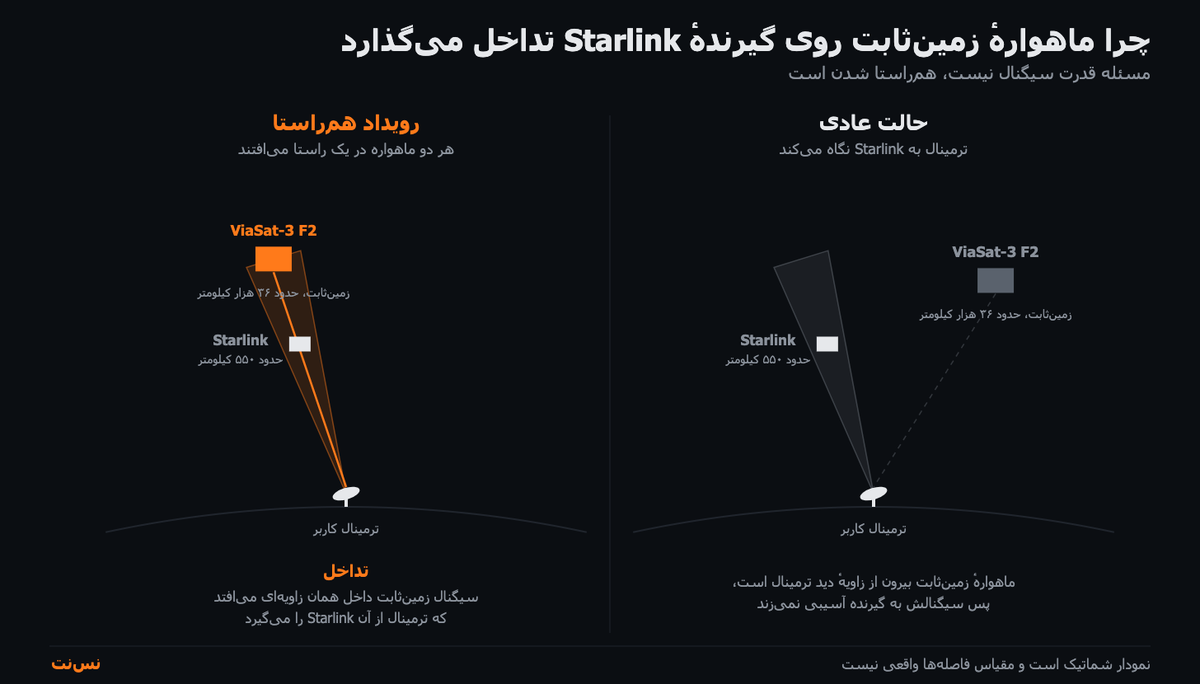
Chart: NasNet. Schematic, distances are not to scale.
EPFD, the rule the case turns on
EPFD stands for equivalent power flux density: a ceiling on how much power density one system is allowed to drop into another system’s receiver. In practice it is the unit for how much noise you are permitted to make in the orbital neighbourhood. According to SatNews, these limits are the core of SpaceX’s argument in this filing.
Where ViaSat-3 actually stands
This case is hard to read without knowing the state of Viasat’s own fleet.
Each ViaSat-3 satellite is designed to deliver more than one terabit per second of capacity and over 100 Mbps to a user, in Ka-band and in geostationary orbit.
The first, F1, launched in May 2023 and ran into trouble deploying its antenna reflector. It now operates at under 10 percent of its designed throughput. Viasat has said it will not replace it and will instead adapt the system around the lost capacity.
The second, F2, launched on 14 November 2025 on an Atlas V. It was originally meant to cover Europe, the Middle East and Africa, but after F1’s failure it was redirected to cover the Americas. This is the satellite SpaceX has filed against.
The third, F3, launched from Kennedy Space Center on 29 April 2026 and has entered service across Asia-Pacific.
SpaceX flew the rocket itself
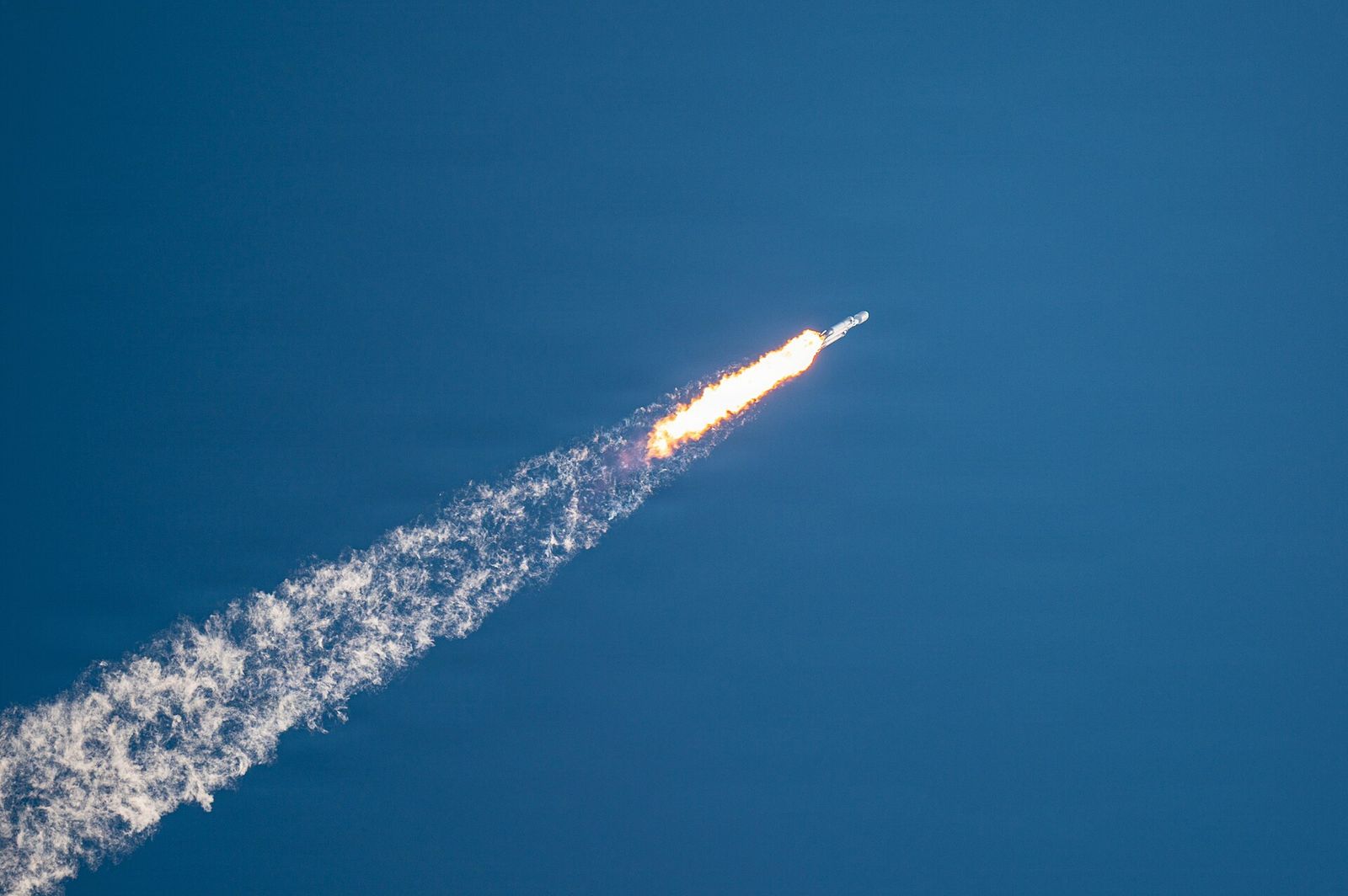
One detail makes the case more interesting to read: Viasat’s third satellite went up on a Falcon Heavy, which is to say on a rocket built by the same company now filing against Viasat’s spectrum at the FCC. Launching the payload is one business. Competing over frequency is another.
What this means for users in Iran
Nothing today. This is a regulatory case inside the United States and it does not touch your dish. But two things in it are worth keeping for understanding where these services are heading.
First, the real ceiling on satellite internet is not satellite count, it is spectrum. You could launch a hundred thousand satellites; the bandwidth usable at one point in the sky is finite and has to be divided among everyone. Every new network added takes from the others’ share and creates a fresh coordination fight.
Second, where these decisions get made. One country’s regulator decides in an administrative docket who may use which frequency, and the people who need these services most are nowhere in that docket.
In closing
The FCC has not decided yet. Whatever the outcome, the pattern repeats: as the number of satellite networks grows, the next fight is over the thing nobody sees and no speed advertisement mentions.
Sources
SpaceX filing at the FCC: SatNews
ViaSat-3 status and the F1 failure: Wikipedia · Data Center Dynamics
Project Kuiper renamed Amazon Leo: Amazon · Via Satellite
Amazon Leo satellite count: KeepTrack