
Announcement
The plant that was meant to launch Rassvet went up in flames
On 15 August Ukraine hit the only plant that assembles Soyuz-2 rockets. That is the rocket carrying Rassvet, Russia’s independent satellite internet project, to orbit.
By Sara Amini
Network engineer
On this page
Russia lost access to Starlink, so Moscow is now building a satellite internet network of its own. The problem is that the only plant assembling the rocket those satellites ride on was hit by cruise missiles in August.
15 August, Samara
On 15 August 2026 Ukraine struck the Progress Rocket and Space Centre in Samara with FP-5 Flamingo cruise missiles. The target sits roughly 900 kilometres inside Russian territory. Zelensky later confirmed the strike on Samara.
Open source analysts working from satellite imagery showed two missiles hitting Building 106A, the shop where onboard electrical equipment, flight control systems, cable harnesses and instrument compartments are installed. One impact left a hole in the roof measuring roughly 35 by 85 metres. Building 106B, where launch vehicles undergo final assembly, sits next door.
How much was destroyed, and how long the line will be down, is still unclear. Russia has offered no technical account and probably will not.
Why Progress matters
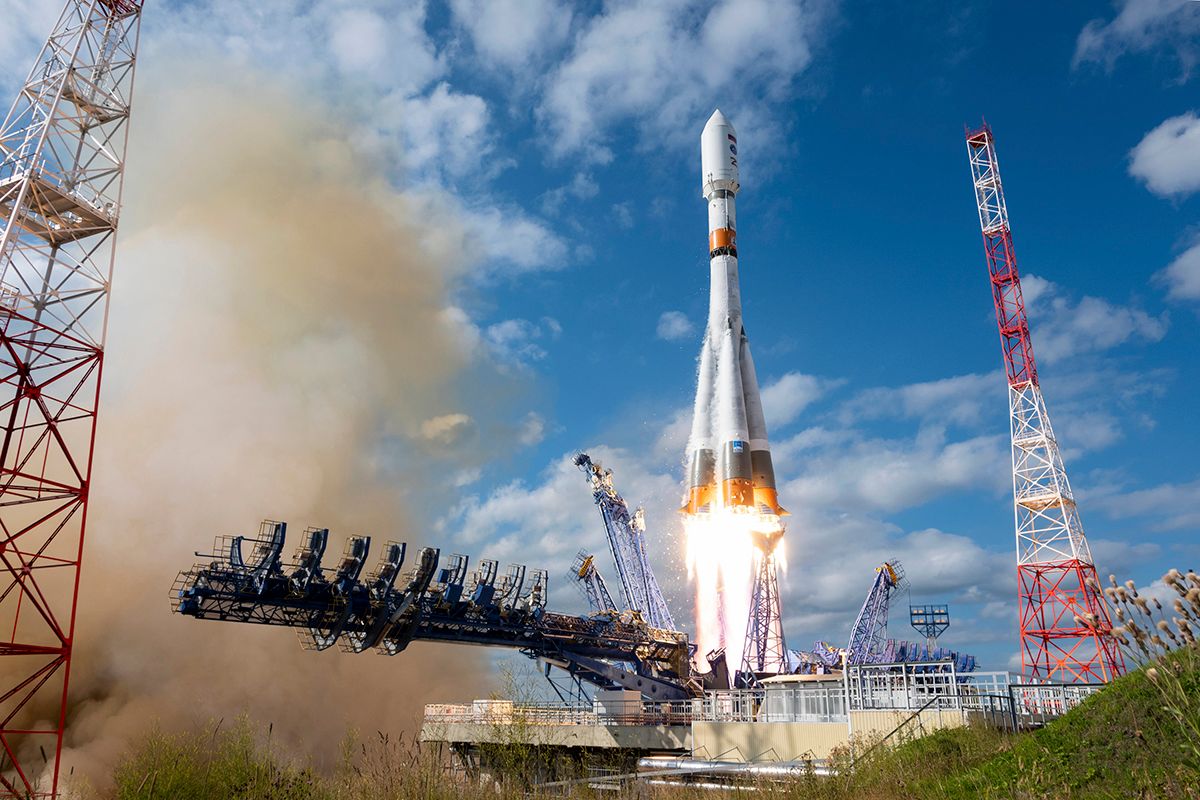
Progress is the only plant in Russia that serially assembles the Soyuz-2 family. The Soyuz-2.1b is the rocket that carried both 2026 batches of Rassvet satellites to orbit.
The technical point is that the damaged shop sits upstream. It is where control systems go in and key components are tested before final assembly. Disruption there does not delay one rocket, it delays the delivery rate.
Why Russia turned to Rassvet
In February 2026 the Starlink terminals Russian forces were using at the front stopped working. From that point Moscow moved an independent satellite network from a long term project to an infrastructure priority.
The project is called Rassvet and the private Russian company Bureau 1440 runs it. The company was founded in November 2020 as a project office of the operator MegaFon, joined X Holding in 2022 and turned into an integrated company designing and building every part of the system.
The money is public. Reports put 102.8 billion rubles (about 1.36 billion dollars) of federal budget into the project, with a further 329 billion rubles (about 4.36 billion dollars) planned through 2030.
The announced plan
What Bureau 1440 has stated on paper:
- commercial service from 2027, with around 250 satellites in orbit by then
- around 730 satellites by 2030
- more than 900 satellites by 2035
The numbers do not agree across sources, which is telling in itself. Ukraine’s defence intelligence puts the plan at 292 satellites by the end of 2027, some reports cite a target of 318 by 2028, and 288 satellites is the figure given for global coverage. Even the schedule and the size of the constellation are unsettled.
Orbital altitude is reported inconsistently too. The system design altitude is given as roughly 870 kilometres, above Starlink’s main shell at around 550 kilometres, while the current operational batches were aimed at 550 kilometres. Part of the constellation is meant to sit in polar orbits inclined at about 88 degrees, and that, rather than altitude alone, is what makes coverage of Russia’s high latitudes possible.
What actually happened in orbit
This is where the gap between the plan and the result shows.
Test launches: three Rassvet-1 test satellites on a Soyuz-2.1b on 27 June 2023, and three Rassvet-2 satellites carrying laser communication terminals on 16 May 2024.
First operational batch: 23 March 2026, 16 satellites. By late July only 12 of them had reached 550 kilometres.
Second batch: 19 July 2026, 16 satellites. As of 31 August 2026 none had reached the target altitude and all were sitting between 300 and 400 kilometres. At least two are heading for reentry. One satellite had already burned up on 6 June 2026.
Sitting in a lower orbit is not just a number on paper. Atmospheric drag is higher there, the satellite burns more fuel holding its orbit, and its useful life gets shorter.
The Institute for the Study of War, in a report on 1 September 2026, did the simple arithmetic: at the current launch rate Russia can put up no more than 128 satellites over four years, and only about 37.5 percent of what has been launched has reached a sustainable operational altitude. The reason for the ceiling is the thing that was hit in Samara: total dependence on the Soyuz-2.1b.
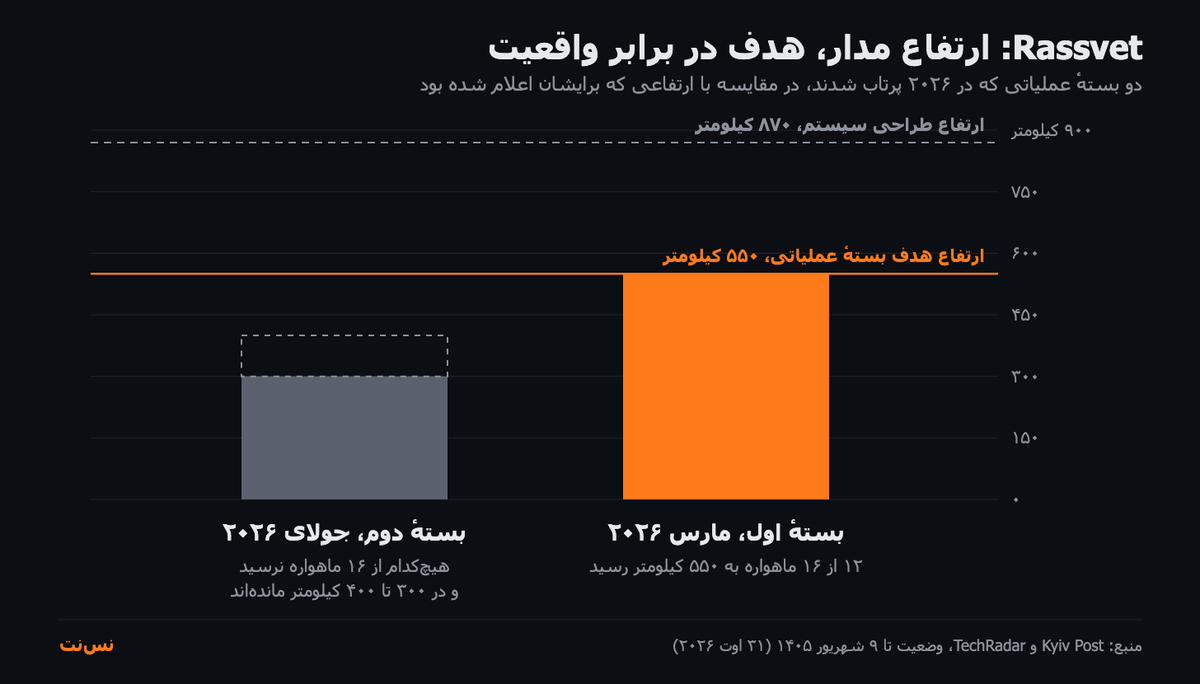
Chart: NasNet. Data from Kyiv Post and TechRadar reporting, status as of 31 August 2026.
Military use, as analysts see it
The 12 healthy satellites from the first batch currently open two communication windows a day over Ukraine, each lasting up to 90 minutes. Windows, not continuous coverage.
For stable round the clock links and practical military use, a Ukrainian defence adviser estimates 200 to 300 operational satellites are needed. An adviser to Ukraine’s president has warned that Russia could fit satellite internet terminals to Shahed drones and time attacks to satellite passes.
For now those numbers are a long way from what is actually in orbit.
Sanctions and the rest of the obstacles
On 27 July 2026 the European Union adopted its twenty first sanctions package. In it, more than 30 designations were aimed explicitly at the manufacturing and supply network behind the Garpiya drone. On Rassvet, a senior EU official said the Russian Starlink project was inside the same package, but neither Rassvet nor Bureau 1440 was named as a designated entity. So there is sanctions pressure on the project, but a direct listing by name is not confirmed.
The remaining obstacles are technical, and sanctions make them worse: mass producing satellites, mass producing user terminals, the cost of building and running the network, and launch capacity. For scale, as of late August and early September 2026 there were around 11,000 Starlink satellites in orbit out of roughly 12,800 launched, Kuiper had about 390, and OneWeb around 650. Rassvet, with about 40 in orbit and some of those stuck at the wrong altitude, is in a different bracket.
What this means for users in Iran
Nothing directly. Rassvet is not a service that will reach Iran, and it is not a rival that has come close to Starlink. But two things in it are worth keeping.
First, the real scale of building an independent satellite network. A country with decades of space industry, its own rocket plant, its own cosmodrome and billions of dollars of state money has about 40 satellites in orbit after three years, and some of those never reached their target altitude. Whenever a national alternative or a homegrown satellite network is announced, these are the numbers that show what the work actually costs.
Second, the difference in model. What makes Starlink useful to someone inside Iran is that the traffic does not pass through domestic infrastructure. Rassvet is exactly the opposite model: a network the state paid for, run by an operator inside that same country, with its ground gateway under the same authority. Satellite internet is not free by nature. What makes the difference is who controls the gateway.
In closing
Russia has evidently decided to treat independent satellite internet as strategic infrastructure, and has put money behind it. But the path runs through a single bottleneck: one rocket family, and one plant that assembles it. August showed that the bottleneck can be reached from 900 kilometres away.
Sources
Chart: NasNet. Data from Kyiv Post and TechRadar reporting, status as of 31 August 2026.
Strike on Progress: Al Jazeera · Kyiv Post · United24 Media
Rassvet and Bureau 1440: Ukrainska Pravda · Kyiv Post · Wikipedia
Orbital status and the ISW report: Kyiv Post · TechRadar · Washington Times
EU sanctions: Euronews
Russia losing Starlink access: Carnegie · The Moscow Times