
Announcement
Satellite on your phone: insurance for the network, not a replacement
Ookla’s data shows D2D connections grew 24.5 percent in nine months, yet in even the leading market under 1.5 percent of users have ever used one. Those two numbers say what the product really is.
By Sara Amini
Network engineer
On this page
For its first few years, a satellite connecting straight to a phone was mostly a good conference demo. Ookla’s data shows it has moved past that and is becoming a real layer of the mobile network. The same data says something else too: the layer is still very thin.
Fast growth, thin usage
Between July 2025 and March 2026 the number of D2D connections Ookla recorded grew by 24.5 percent. Investment in the space has topped 40 billion dollars over the past year, according to Ookla’s own reporting.
The geography of those connections is not even:
- United States, 45.9 percent of samples
- Australia, 18.1 percent
- Chile, 10 percent
- Canada, 9.8 percent
- United Kingdom, 4.5 percent
These markets share one thing: large areas with thin terrestrial coverage. Most of the connections were Starlink, though AST SpaceMobile, Skylo, Lynk Global and Amazon Leo also appear in the data.
But who is actually using it
This is where the numbers change tone. The share of users who recorded even one D2D connection in March 2026 did not reach 1.5 percent in any market. New Zealand leads at 1.41 percent, then Chile at 1.26, Peru at 1.08, Australia at 1.07, Canada at 0.70, the US at 0.46, the UK at 0.30, Ukraine at 0.16 and Japan at 0.11 percent.
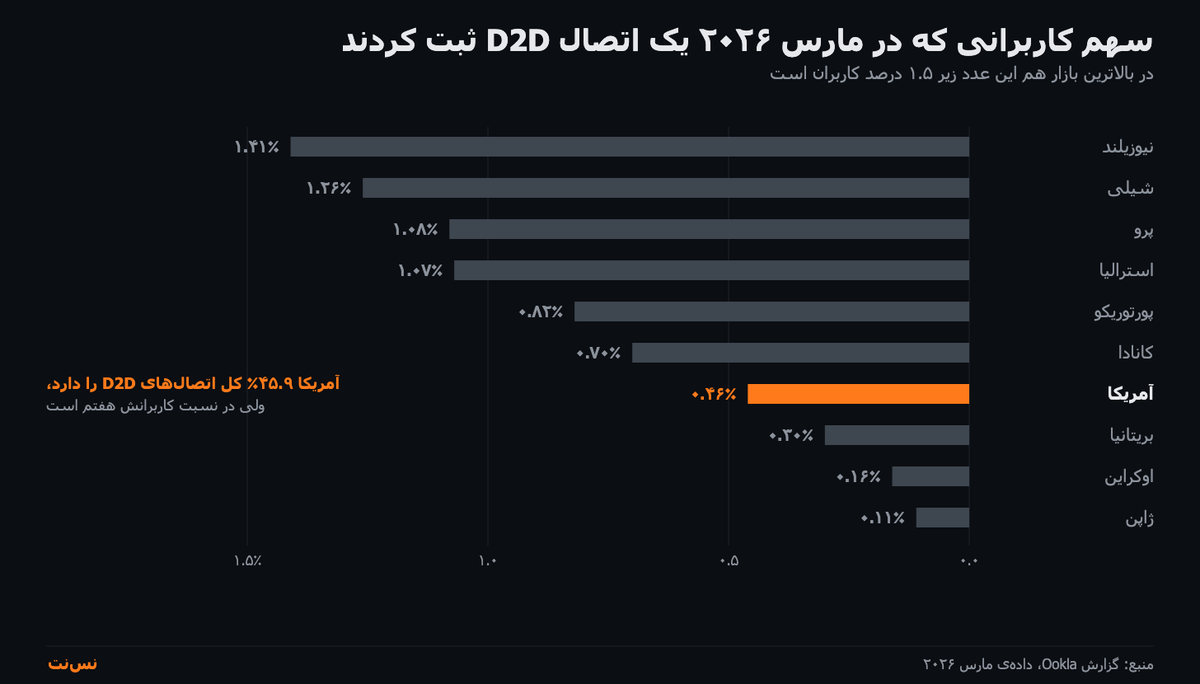
Chart: NasNet. Data from Ookla’s report, March 2026.
Note that the US holds close to half of all connections but ranks seventh by share of its own users. Connection volume and penetration among users are two different things.
What the drive test actually shows
In the second half of 2025 RootMetrics ran a moving test in rural New York on Starlink’s D2D network. Of 238 attempts to send and receive a text message, 143 succeeded, about 60 percent. Average transmission time was one minute and 17 seconds, the fastest message arrived in a second, and the slowest took around five minutes. Signal strength was recorded between minus 108 and minus 126 dBm.
The test conditions matter: inside a moving vehicle. Today’s D2D services are designed for outdoor, stationary use with a clear view of the sky, not for a phone being carried along a road.
And a few months have already made a difference. In its later reporting Ookla says that in drive testing across the US in the first half of 2026, roughly nine out of ten texts got through from a moving vehicle. In Oregon, D2D shows up in as much as 5.7 percent of drive test samples, concentrated in the rural areas where terrestrial coverage gaps are most common.
Venezuela, where the layer actually worked
The best practical demonstration of this technology was a crisis, not a campaign.
After earthquakes in Venezuela knocked out terrestrial networks, the regulator authorized D2D quickly and all three national operators partnered with Starlink almost immediately. Ookla cross-referenced its network data with seismic data from the US Geological Survey and found that the areas with the most severe shaking also carried the greatest volume of D2D satellite connections, while terrestrial scan counts fell as power and infrastructure failed.
That is exactly the job this layer was built for.
When the money arrived, the connections dropped
There is an economic signal in the data too. T-Mobile in the US and Rogers in Canada began charging some subscribers for D2D, on plans under 15 dollars a month. Over the same period Ookla saw connection counts fall in both markets. The report is careful to note other factors, including seasonality, since people spend less time outside terrestrial coverage in the cold months.
The bottlenecks: regulators, rockets and handsets
The report separates out three constraints.
Regulators. In Europe there is no commercial D2D service outside the UK and Ukraine, and the reason is regulatory pace rather than any technical limit. The European Commission plans to split the 2 GHz MSS band into three categories: one for government-facing services, one reserved for European companies and one open to all players including SpaceX and Amazon Leo. Some observers expect broader European rollout to wait until 2028 or later. The US and Australia are moving faster in different ways, the first by opening more spectrum, the second by requiring a baseline of D2D coverage for emergency communications.
Rockets. Bigger D2D satellites perform better but need bigger rockets and reliable launch schedules, and few companies can supply that today. Starship sits at the centre of many of these plans.
Handsets. Even once a band is approved in 3GPP standards, device makers are not obliged to support it, and phones stay in people’s hands for years. So even if everything else is solved, compatible hardware takes time to spread.
What the real product is
Put these numbers together and the picture that emerges is this: today’s D2D product is not satellite internet on a phone. It is an insurance layer for the mobile network.
A layer you may not need 99 percent of the time, but in the remaining one percent, on a road, a mountain, at sea or in a crisis, it can be worth more than the whole ordinary network. Ookla says the same thing: coverage, not speed, is D2D’s defining strength.
If we eventually get from text messages and thin data to real broadband, it will not just change the user experience. It changes the economics of building mobile networks in sparsely populated areas, because you no longer need a tower for every valley.
What this means for users in Iran
First, clear up a confusion that comes up a lot. D2D is not Starlink with a dish. Hearing that Starlink works on your phone does not mean your phone does anything today. D2D only works when the handset has the hardware and the band, your operator has a deal with a satellite provider, and the country’s regulator has allowed it. In Iran none of those three conditions holds.
Second, and more important: the Venezuela model does not repeat in a deliberate shutdown. There, an earthquake took the network down and the regulator was itself looking for a way to restore service, so it issued authorization within days and the operators connected. In a deliberate shutdown, the body that would have to authorize D2D is the one ordering the shutdown. So do not count on this technology as a way around a shutdown. The structure does not allow it.
What has not changed for you is this: the path that does not run through domestic infrastructure is still the satellite terminal, not the phone. D2D is a useful layer for the world’s uncovered places, but it is not the answer to our problem.
In closing
A 24.5 percent growth rate is a big number and under 1.5 percent is a small one. Both are true, and together they mean something: the technology has left the demo stage and entered the network, but it sits in a part of the network you only notice when the rest of it is gone.
Sources
Ookla’s D2D article: Ookla
Growth figures, country shares and the RootMetrics test: RCR Wireless · Light Reading
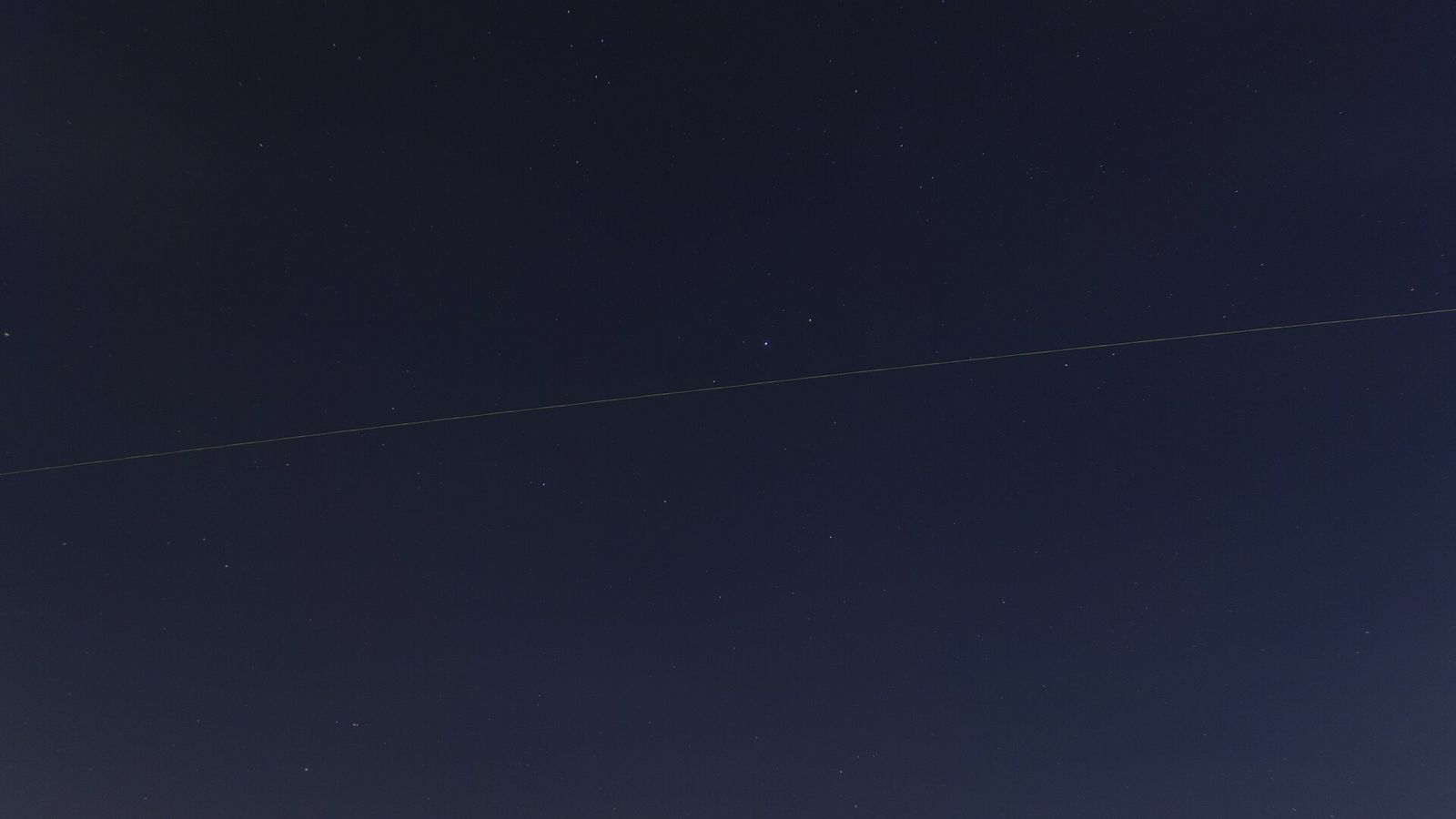
Cover image: a Starlink satellite train seen from the ground, photo by Farhill, licensed CC BY-SA 2.0. Resized for the site.
